Neurophysics & Adaptive Systems

CIFT — Cortical
Informational
Field Theory

A field-theoretic framework for cognition, consciousness, learning, and near-critical cortical dynamics.

CIFT models cognitive performance as an emergent property of system configuration, rather than treating it merely as an intrinsic subject capacity.

CIFT Dynamic Model
Ensayo Filosófico · Acceso Libre

El Peso de la Conciencia

"Las preguntas que todos hacen en silencio"

Un ensayo filosófico sobre la experiencia consciente, la identidad y la dinámica del ser, explorado desde la perspectiva del campo informacional cortical. Disponible en acceso abierto — el conocimiento no tiene dueño.

Danko Stjepovic-Gonzalez · Viña del Mar, Chile · 2026

El Peso de la Conciencia

What is CIFT?

Cortical Informational Field Theory (CIFT) is a theoretical framework that models brain dynamics as a near-critical continuous field. Inspired by Ginzburg-Landau equations, it explains how cognition, consciousness, and behavioral variability emerge from large-scale cortical interactions.

Key Concepts

ADHD is not a deficit.
It is a near-critical cortical regime (RC³).

Learning outcome is strongly influenced by system configuration.

Environmental design can shift effective regime stability.

Consistent with known variability and network reconfiguration patterns observed in ADHD.

What is CIFT?

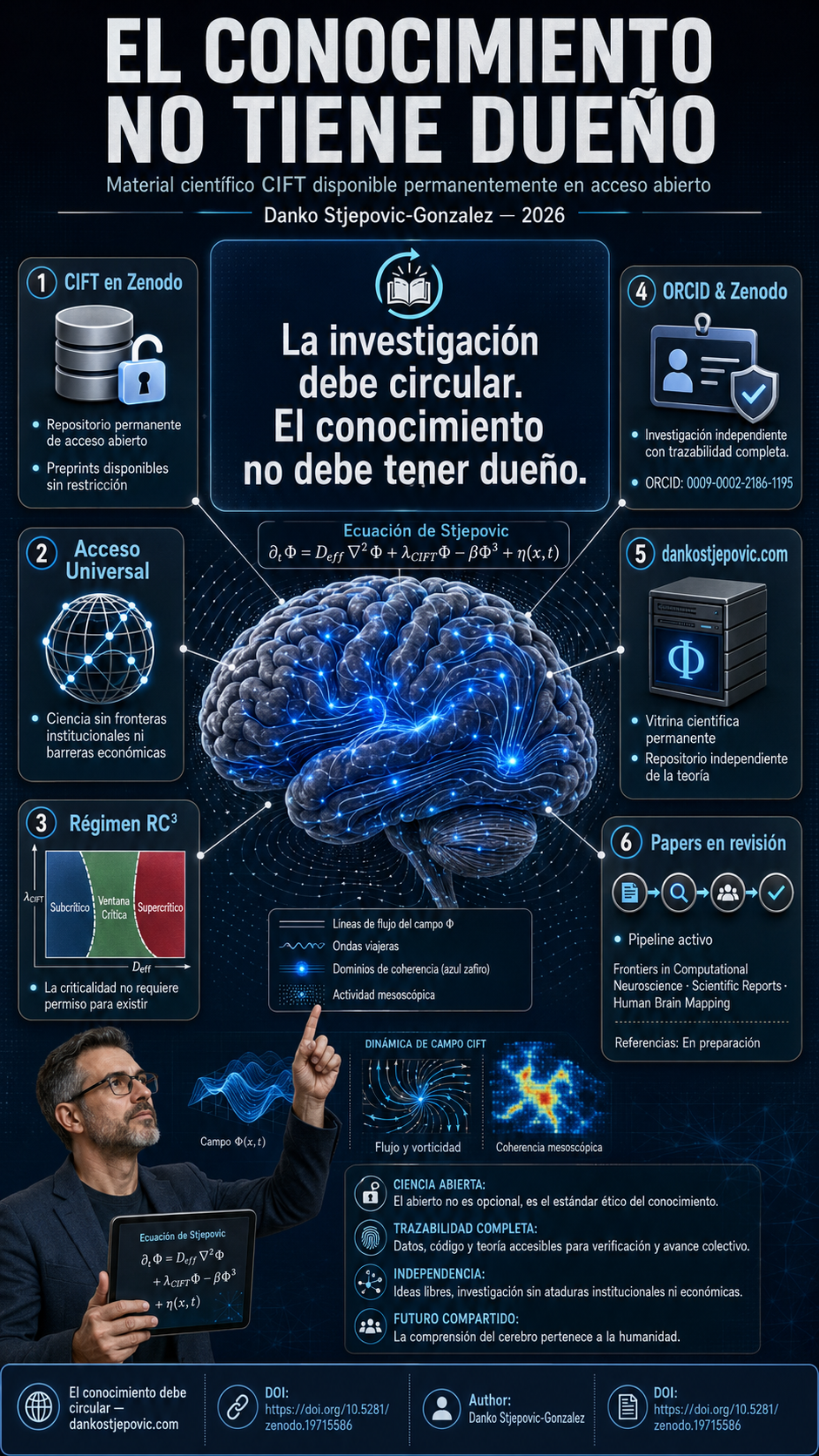
CIFT is a mesoscopic framework that models the cortical field as a coarse-grained dynamic system using a Ginzburg-Landau formalism.

It provides a mathematically tractable way to describe integration, differentiation, and stability across cortical dynamics.

Within this view, cognition is not treated as a fixed property of the subject alone, but as an emergent regime shaped by the interaction between biological parameters, contextual admittance, and stochastic fluctuation structure.

Governing Equation
tΦ = Deff∇²Φ + λΦβΦ³ + χΦ + η
  • λ excitation-inhibition control block
  • χ contextual admittance
  • η stochastic fluctuation / noise
  • ΔU attractor stability landscape

Regime Transition in CIFT

Sociability is not a fixed trait, but an emergent property of cortical field dynamics under different environmental conditions.

CIFT Applied to ADHD Sociability — Regime Comparison

CIFT applied to ADHD sociability

State A — Unstructured Environment

  • • High stochastic noise (η ↑)
  • • Low contextual admittance (χ ↓)
  • • Reduced coherence length (ξ → collapse)
  • • Fragmented cortical field dynamics

Associated with instability, high executive load, and social overwhelm.

State B — Structured Environment

  • • Reduced dynamic uncertainty
  • • High external admittance (χ ↑)
  • • Increased coherence length (ξ ↑)
  • • Stabilized cortical field

Supports integration, coordination, and fluid social interaction.

Social functioning is not solely a property of the individual, but emerges from the interaction between cortical dynamics and environmental structure.

The Full CIFT Research Program

CIFT is not a single model, but a multi-paper scientific program describing cortical dynamics across theoretical and applied domains.

Papers I–IV

Foundations of cortical informational dynamics, memory, and learning.

See Details
Paper V

ADHD reframed as a near-critical cortical regime.

Read Paper
Paper VI

CIFT-EXEC protocol derived from first principles.

Read Paper
Paper VII

Naturalistic implementation and proof-of-concept validation.

Read Paper

Key Concepts

Cognition as field dynamics
RC³: near-critical instability
Admittance & environmental modulation
Attractor stabilization
Adaptive learning by design
CIFT-EXEC Translates Field Theory

CIFT-EXEC translates field theory into adaptive educational design.

Adaptive Design

System-level parameter mapping customized for near-critical experiential learning regimes.

Modulation of χ(x,t)

Real-time contextual admittance tuning maintaining the desired cognitive environment.

Rapid Feedback

Fast iterative coupling to actively avoid and recover from regime destabilization.

Noise Control

Demand-sensitive attenuation of stochastic fluctuation (η) throughout implementation.

Reward Coupling

Structured reinforcement strategies across multiple progressive timescales.

Multi-Scale Architecture

Nested implementation loops operating strictly from milliseconds to months.

Multi-Scale Architecture

Structured nested loops operating across the temporal scales outlined in Paper VII.

Micro

Fast Loop

Action

Trial Loop

Block

Session Loop

Term

Cuatrimestre Loop

Macro

Annual Loop

Key Result

Under RC³ conditions, learning outcomes are strongly influenced by system configuration.

Proof-of-concept evidence suggests that structured parameter modulation can stabilize learning performance in naturalistic conditions, independent of traditional intrinsic limitations.

~2h in 12mo
Observed in a naturalistic proof-of-concept (~2 hours cumulative exposure)
~10m
Per month encoding rate
Naturalistic
Exposure environment
Stability
Stabilization observed under structured conditions

Live System

Interactive implementation of the CIFT-EXEC environment.

Real-time modulation of χ(x,t), λ_eff, and noise structure.

Launch Demo

Publications & Open Science

The main theoretical and applied pieces of the CIFT research program.

Featured Paper VII

Adaptive learning systems & implementation

CIFT-EXEC as a naturalistic implementation of system-level adaptive design. Explores rapid skill acquisition and modulation tracking.

Core Protocol Paper VI

CIFT-EXEC Intervention

Translating field theory into educational design through real-time admittance tuning. Details the parameter stabilization loops.

Clinical Theory Paper V

ADHD as RC³

Redefining ADHD as a near-critical cortical regime rather than a deficit model, outlining structural dependencies.

Base Framework Papers I–IV

Informational Dynamics

Foundations of cortical field structure, memory emergence, and the formal Ginzburg-Landau mapping equation.

Why It Matters

Education Neurodivergence Cognitive Theory Consciousness Adaptive Design Open Science

CIFT aims to bridge theoretical neuroscience, complex systems, and real-world adaptive design.

¿Qué es CIFT?

La Cortical Informational Field Theory (CIFT) es un marco teórico que modela la dinámica cerebral como un campo continuo cercano a un régimen crítico. A través de una ecuación tipo Ginzburg-Landau, describe cómo emergen la conciencia, la integración de información y la diferenciación funcional en el cerebro.

Aplicaciones

Latest Research